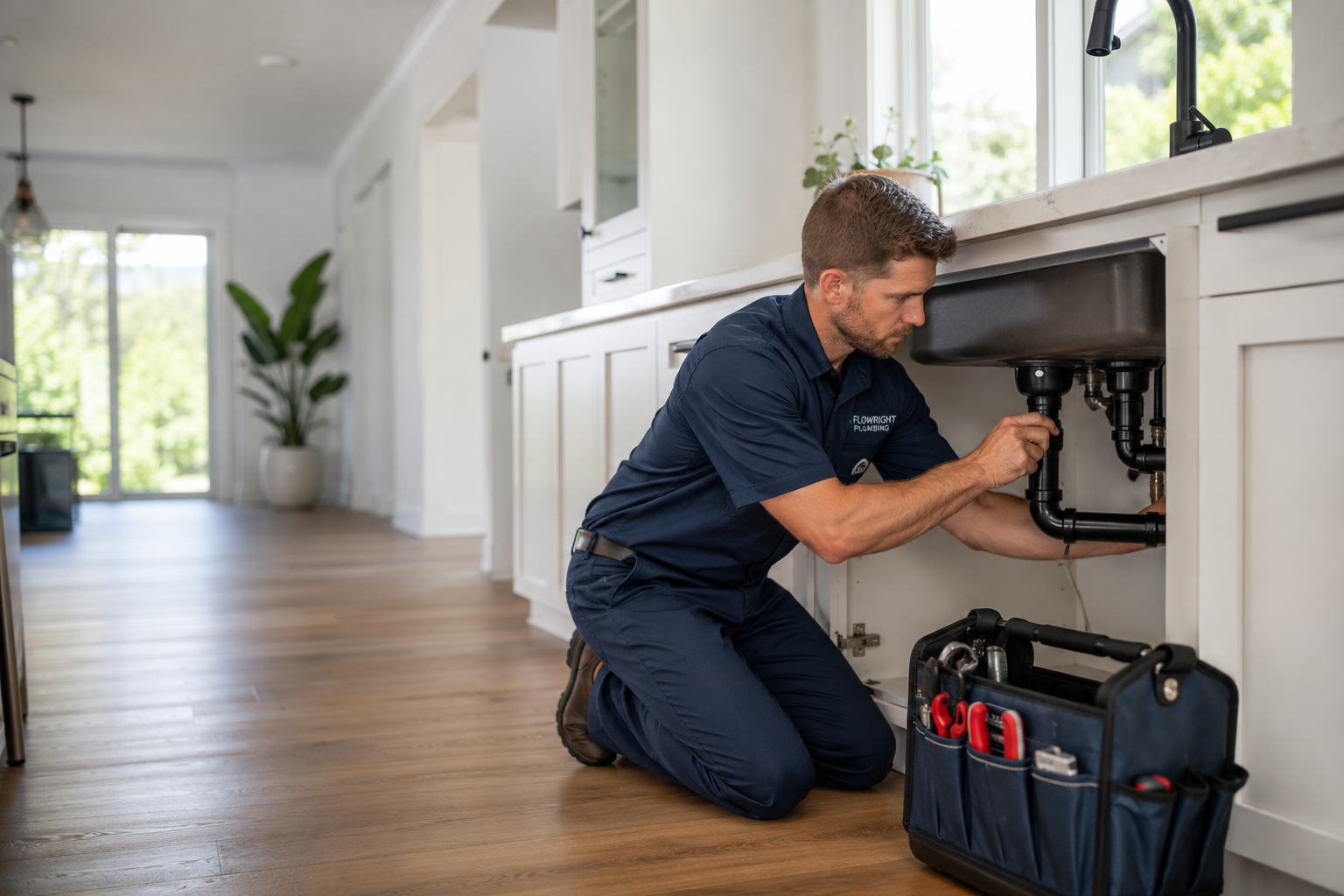
You answer the phone in your truck, three jobs behind, and see a missed call from 45 minutes ago. By then, the homeowner has already called your competitor. A plumbing virtual receptionist is a live, remote team member who answers every incoming call 24/7 — capturing customer details, scheduling appointments, and routing emergencies — without the $40,000-plus annual cost of a full-time front-desk employee. For plumbing companies losing jobs to voicemail and spending half their payroll on reception coverage, a virtual receptionist delivers the same customer experience at a fraction of the overhead.
What a Plumbing Virtual Receptionist Does vs a Real Receptionist
A virtual receptionist handles the same core tasks as an in-house front-desk person — call answering, appointment scheduling, and emergency routing — but without salary, benefits, or turnover costs.
Call answering and live greeting — no routing to voicemail
When a customer calls, a live person answers. Not an IVR. Not an AI. A trained human who greets them with your company name and professional tone. This is non-negotiable for plumbing — customers calling with a burst pipe at 11 PM need to hear a person, not a menu. Your virtual receptionist answers within 3 rings, captures the caller's name and issue, and keeps them engaged while you're mid-job across town.
Appointment scheduling and calendar management synced to your dispatch system
Your virtual receptionist doesn't book appointments in a separate system. They integrate directly with your dispatch software — ServiceTitan, Housecall Pro, or whatever platform your team uses. When they schedule a call-out for Tuesday at 2 PM, your dispatch system sees it instantly. No double-booking. No "oops, that tech is already at a job." The customer gets a confirmation text automatically, and your team sees the details (address, issue, special notes) before they even roll up.
Emergency call screening and after-hours routing to on-call techs
You set the rules. "If it's a burst pipe after 6 PM, route it to [technician name]." Your virtual receptionist follows that protocol every single time, without judgment calls or missed transfers. Non-emergency calls at 2 AM? They offer next-morning scheduling or take a detailed voicemail so you're not woken up. This is customer service and efficiency in one move — emergencies get priority, non-urgent issues don't disrupt sleep.
85%
of customers who reach voicemail never call a plumbing company back — meaning every missed call is a lost job.
The Cost Comparison: Virtual vs In-House for Plumbing Companies
A full-time in-house receptionist costs $40,000–$50,000 annually in salary, taxes, and benefits; a virtual receptionist costs $400–$600 monthly ($4,800–$7,200 yearly) with zero hidden expenses.
In-house receptionist salary + benefits breakdown: $40K–$50K annually
The job posting says $38,000 a year. That's not what it costs you. Add payroll taxes (15.3%), workers' compensation insurance ($600–$1,200/year), health insurance if you offer it ($4,000–$8,000/year), paid time off (10 days = ~$1,450), and equipment (desk, phone, software licenses, training). Real total: $48,000–$60,000 per year. Then factor in turnover. Receptionists average a 2-year tenure. Every time you hire, you lose 2–3 weeks to training and ramp-up. That's 6 missed weeks of productivity every 24 months.
Virtual receptionist pricing: $400–$600 per month (flat or usage-based)
Most virtual receptionist services, including ARIZN, charge a flat monthly rate or a blended usage model. $400–$600 monthly covers unlimited calls, scheduling, and integration with your dispatch system. No hidden fees. No payroll taxes. No sick days. No equipment. No training friction. If you get busier and go from 50 calls a week to 150 calls a week, your cost stays the same. With an in-house receptionist, you'd need to hire a second person ($25,000–$30,000 more).
Hidden costs of turnover, training, and payroll management
Your accountant spends 2 hours a month processing payroll, filing taxes, and managing compliance. That's $250–$400 per month in admin overhead. When your receptionist quits, you spend 20 hours recruiting, interviewing, and onboarding the replacement. At $25/hour of your time, that's another $500. Over a year, in-house reception costs you not just salary and benefits, but dozens of hours of your personal labor and distraction. A virtual receptionist removes that entirely.
How Scheduling and Dispatch Work With a Virtual Receptionist
Your virtual receptionist integrates directly with your dispatch software, syncing real-time availability so calls are booked into open slots instantly — no double-booking, no extra work for your team.
Two-way integration with your existing dispatch software (ServiceTitan, Housecall Pro, etc.)
The integration works like this: Your dispatch system is the source of truth for tech schedules. Your virtual receptionist's scheduling interface pulls live availability from that system every 60 seconds. When a customer calls Monday at 10 AM, your receptionist can see which techs have open slots Tuesday and Wednesday. They book the appointment directly into the calendar. Your dispatch system updates. Your tech gets a notification. No spreadsheets. No phone calls between front desk and field. No conflicts.
Automated appointment confirmation texts and customer reminders
After the appointment is booked, the system automatically sends the customer a confirmation text with the date, time, and tech name. The day before, they get a reminder. This reduces no-shows by 25–30%, which means higher revenue per scheduled call. Customers appreciate the touchpoints; your team spends zero time on manual follow-ups.
Real-time availability sync so your virtual receptionist never books a slot that's full
A common fear: "Won't the virtual receptionist double-book me?" The answer is no — as long as your team keeps your dispatch calendar current. If your tech finishes a job early, you update the calendar in real-time. The virtual receptionist sees that slot is now open and can offer it to the next caller. If a job runs long, your tech marks it, and the system reserves that tech as unavailable. The virtual receptionist never has outdated information. This eliminates the scheduling conflict entirely and keeps customers happy because they rarely see reschedules.
What Customers Experience When They Call Your Plumbing Business
Customers hear a live person answer on the first or second ring, get booked into an appointment without transfers or delays, and receive instant confirmation — the same professional experience as calling a company with a full office staff.
Live human answering from the first ring — no hold menus or press-1 delays
Ring, ring. "Thanks for calling [Your Company]. This is [Name]. How can I help you?" That's it. No "press 1 for emergency," no hold music, no frustration. The caller feels heard immediately. For a plumbing emergency — a flooded basement, a burst line — this moment of direct contact is huge. It builds trust. Studies show that 78% of customers choose the first business that responds. A live answer beats voicemail every time.
Professional greeting customized to your plumbing company's voice and brand
Your virtual receptionist team learns your company's personality. Are you a blue-collar, no-BS outfit? They talk like it. Are you premium, high-touch service? They reflect that tone. They know your service areas, your pricing, your response times, and your brand story. A caller to your business hears professionalism, not a generic script. This consistency reinforces your brand and makes customers feel like they're calling a real, organized operation — because they are.
Same-day or next-available appointment offered without transferring the call
The caller explains the problem. Your virtual receptionist captures details (address, issue type, urgency level), checks availability, and says, "I can get someone out to you Tuesday at 2 PM. Does that work?" No warm transfer to a manager. No waiting for a callback. The appointment is booked, confirmed, and locked in before the call ends. This dramatically increases close rates because the friction is gone. Customers don't have time to shop around or call your competitor.
How to Set Up a Virtual Receptionist for Your Plumbing Company
Setup takes 15 minutes: connect your phone number and dispatch system, brief your virtual receptionist team on your protocols, and go live — most plumbing companies see 95%+ call answer rates on day one.
Connect your phone number and dispatch system (takes 15 minutes, no new number needed)
You don't change your phone number. You forward your existing line to the virtual receptionist service. They answer under your number, and when a call needs to be routed (a tech consult, a callback), you can transfer it manually or set up automatic routing. Most services integrate with ServiceTitan, Housecall Pro, or your dispatch platform in under 15 minutes — no IT team needed. You're done by lunchtime.
Brief your virtual receptionist team on your service areas, pricing, response times, and emergency protocols
You spend 30–45 minutes on an onboarding call with your virtual receptionist team. You tell them: "We service [neighborhood], respond within 24 hours for non-emergencies, charge $X for a diagnostic, and route burst-pipe calls to [tech name] after 6 PM." They take notes, ask clarifying questions, and absorb your business. They review your website, past customer calls (if available), and any FAQ. This brief investment ensures they answer like your team, not like a stranger.
Test a few calls, then go live — most plumbers see call answer rates jump to 95%+ on day one
Before full launch, you (or a team member) call in to test the greeting, scheduling, and transfer process. Does it feel right? Does the receptionist understand your service areas? If adjustments are needed, they take 10 minutes. Then you go live. Real calls start flowing. Your team notices immediately: the phone isn't ringing in the field as much because calls are being answered at the source. By the end of week one, you've likely recovered 5–10 calls that would have been missed. That's $1,250–$2,500 in new revenue already.
Frequently Asked Questions
Will customers know they're talking to a virtual receptionist?
No. A live virtual receptionist is trained to answer with your company name and greeting, exactly like an in-house front-desk person would. The only difference is they're not sitting in your office — and customers will never know that. They hear professionalism, warmth, and knowledge about your business.
What happens if my virtual receptionist misses a call?
Most virtual receptionist services have a 99%+ answer rate and failover to your voicemail or backup number if needed. ARIZN uses multiple receptionists and load balancing to ensure calls are answered in under 3 rings. You also get a full call log so you can spot trends and identify peak times when you might want extra coverage.
Can a virtual receptionist handle emergency calls after hours?
Yes. You set protocols — for example, "Route emergency calls to [tech name] after 6 PM," and the virtual receptionist follows that every time. For non-emergency calls at 2 AM, they can offer next-morning scheduling or an after-hours voicemail. This way, emergencies get priority, and your team isn't woken up for routine inquiries.
What if I already have a part-time receptionist — do I need to replace them?
Not necessarily. Many plumbing companies use a hybrid model: virtual receptionist handles the bulk of calls during business hours, and your part-timer works 15–20 hours per week on other admin tasks (billing, follow-ups, social media). This cuts your payroll in half and keeps coverage 24/7. You get the best of both worlds: human touch and cost savings.
How much will a virtual receptionist actually improve my revenue?
If you're missing 10 calls a week at a 35% close rate and $250 average job value, you're leaving $43,750 on the table annually. A virtual receptionist captures those calls. Even recovering 50% of missed calls adds $21,875 in new revenue per year — paying for the service 4–5 times over. Most of our plumbing clients see ROI within 60 days.
A plumbing virtual receptionist answers every call live, schedules appointments into your dispatch system automatically, and routes emergencies correctly — delivering in-house reception quality at one-eighth the cost. For a typical plumbing company losing $43,750 annually to missed calls, a virtual receptionist at $5,400 per year recovers most of that revenue while eliminating payroll overhead, turnover costs, and hiring friction. Setup takes 15 minutes, customers never know the difference, and your team sees zero extra work. The only mystery is why you haven't done it yet.
Stop Losing $875 a Week to Missed Calls
See exactly how much revenue you're leaving on the table — and how a virtual receptionist recovers it.
Take the Free Assessment →